Most executives hiring specialized remote support operate under a fundamental misunderstanding. They view soft skills such as niceness, organization, or a pleasing telephone voice, as passive skills, yet they prioritize the hard skills of scheduling and email management.
This misconception is the single greatest impediment to achieving a truly seamless executive VA partnership.
In the context of high-level business, soft skills are not passive traits; they are active, measurable, high-leverage business competencies that directly reduce cognitive friction and free the executive for strategic focus. The partnership stalls when the executive adheres to the myths of soft skills instead of embracing the high-stakes reality.
To transform your outsourced investment from administrative expense into strategic leverage, you must deconstruct the three most common myths surrounding the executive VA soft skills required for success.
The Communication Gap
Myth: Good Communication Means Fast Replies
Executives often prioritize rapid response times, mistaking speed for efficiency. The myth is that communication success is measured by the time it takes to reply to a request.
Reality: Good Communication Means Engineering Zero-Ambiguity
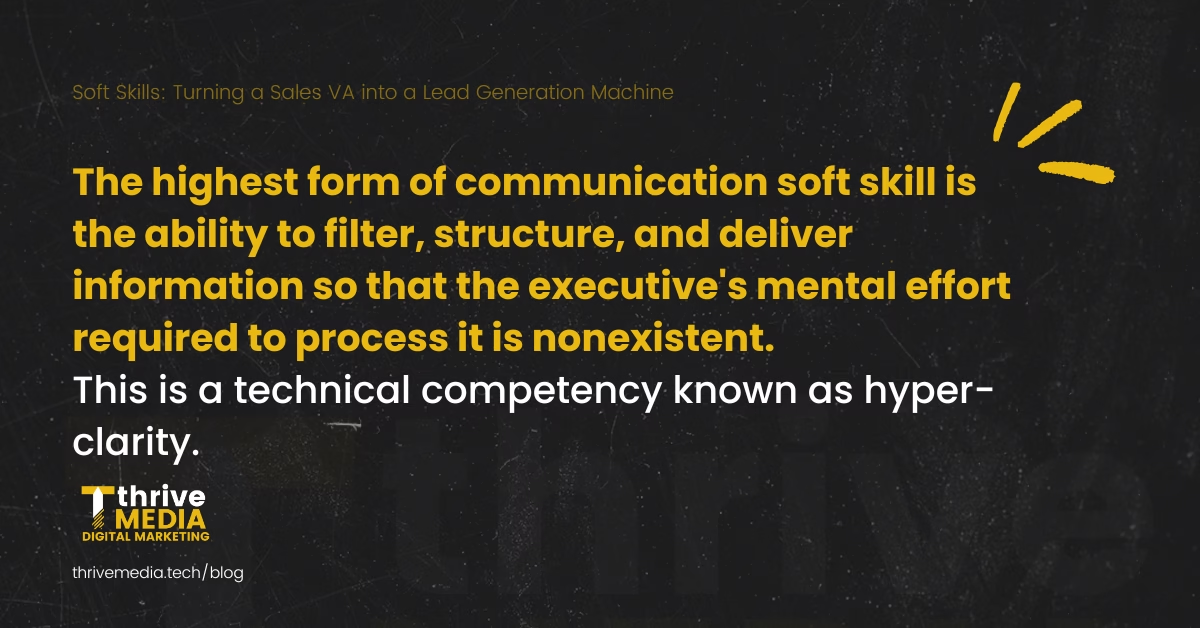
The highest form of communication soft skill is the ability to filter, structure, and deliver information so that the executive’s mental effort required to process it is nonexistent. This is a technical competency known as hyper-clarity.
- Strategic Summarization: The professional doesn’t forward a 12-email chain from a vendor; they deliver a three-sentence summary, a recommendation, and the next two necessary action items. This highly refined process is a powerful executive skill that saves minutes on every decision, accumulating into hours of recovered executive time.
- Contextual Filtering: The specialist knows that clarity means proactively discerning signal from noise. They manage the flow of information, shielding the executive from internal gossip, low-priority vendor inquiries, and irrelevant organizational chatter. They operate as a human firewall, ensuring only actionable intelligence reaches the top level.
- Nuanced Digital Tone Management: Across distributed teams, tone is critical. The professional must possess the V-EQ (Virtual Emotional Intelligence) to know when to be strictly factual (internal finance) versus when to be warmly diplomatic (external clients). This soft skill preserves the executive’s reputation and minimizes misinterpretation across cultural distances.
The Executive Takeaway: Do not evaluate for speed. Scrutinize their structure. Ask for examples of how a complex email chain was reduced to a single, actionable paragraph.
The Ownership Gap
Myth: Ownership Means Accepting All Tasks
Many executives believe ownership is demonstrated by a willingness to take on any task assigned. They delegate and then assume the professional will handle it. This often leads to the professional waiting for the next explicit command or escalating the first sign of difficulty.
Reality: Ownership Means Solving the Next Two Problems
True ownership is the soft skill of anticipatory initiative. It means recognizing that every completed task generates new requirements. A world-class professional is not merely a task-taker; they are a solution-driver who operates two steps ahead of the executive’s thinking.
- Proactive Task Extension: When scheduling a critical client meeting (the primary task), the professional doesn’t stop there. They proactively secure the necessary presentation deck, research the client’s latest press release, and flag the relevant contract details for review. They anticipate the resources the executive will need after the meeting is confirmed.
- Independent Problem Curation: When a problem inevitably arises (e.g., a software system fails), the professional with strong executive VA soft skills never presents the problem alone. They quickly triage the issue, develop two or three potential fixes, and present the executive with only the options, the cost of each, and their recommended course of action. The executive only needs to make one high-level decision, not absorb a crisis.
- Strategic Boundary Setting: The soft skill of saying “no” (or, more diplomatically, “not now”) is essential. They advocate for the executive’s schedule, ensuring time is protected for high-impact work by managing expectations and deflecting requests that fall outside the strategic priorities.
The Executive Takeaway: You should not hire someone to execute tasks; you should hire someone to outsource problems. Look for evidence that the remote professional views their role as autonomously driving strategic momentum.

The Trust Gap
Myth: Trust Is Built Slowly Over Time
Executives often treat high-level delegation and confidential access as something that must be “earned” over years of demonstrated competence. This slow-burn approach is a significant bottleneck, preventing the partnership from reaching its highest potential.
Reality: Trust Is Established Through Unwavering Discretion
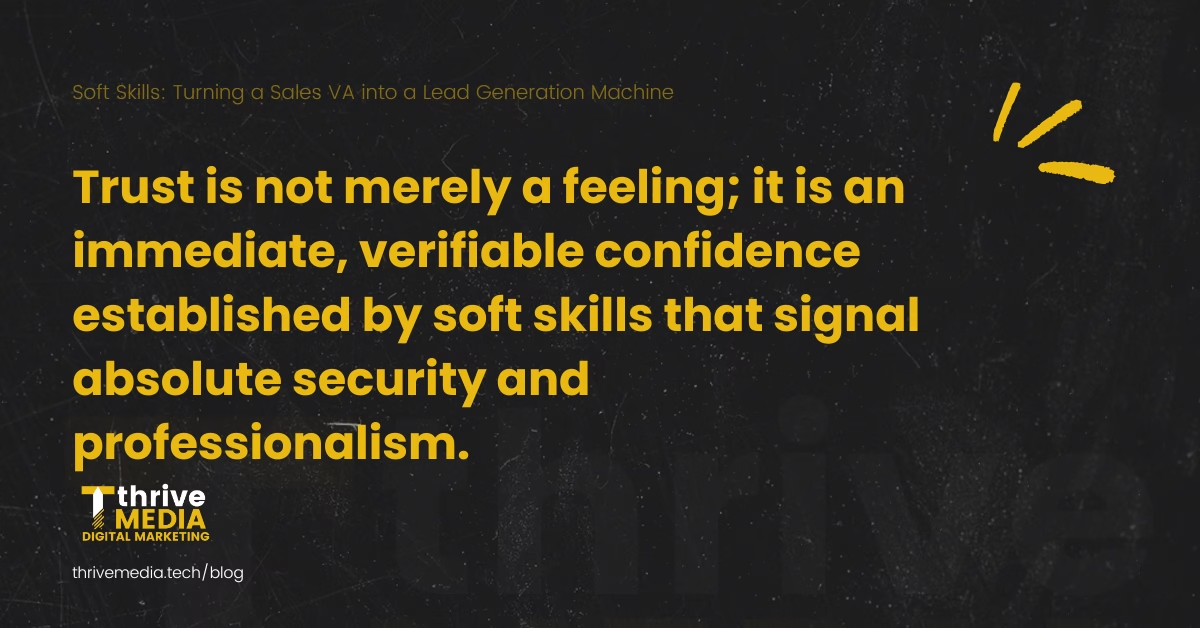
At the executive level, trust is not merely a feeling; it is an immediate, verifiable confidence established by soft skills that signal absolute security and professionalism. This is the capital of discretion.
- Implicit Confidentiality Protocol: The professional’s soft skill set includes handling sensitive information (personnel issues, M&A activity, personal logistics) with an innate, quiet understanding of its gravity. They avoid unnecessary commentary, keep private details compartmentalized, and maintain a professional distance that ensures the executive’s psychological safety is never compromised.
- Strategic Advocacy and Loyalty: A professional operating at the apex of trust functions as a steadfast advocate, protecting the executive’s time and reputation both internally and externally. They handle sensitive conflicts with tact, correct inaccuracies, and manage external communications with a loyalty that is immediately evident to stakeholders.
- High-Stakes Judgement: The professional understands that their judgment in moments of high pressure, such as a last-minute crisis or a sudden change in schedule, is a direct reflection of the executive. They possess the soft skill to rapidly prioritize, make a call based on limited data, and communicate the decision with absolute certainty, ensuring the executive’s interests are protected above all else.
The Executive Takeaway: You must be able to trust your remote partner implicitly from day one with high-stakes information. Assess their understanding of unwavering discretion. This is the indispensable foundation on which a truly seamless partnership is built.
The Seamless ROI: Trading Myths for Measurable Gain
The cost of operating under these soft skill myths is measurable: it’s the executive time lost to micro-management, clarification loops, and repeated decision-making.
By securing specialized remote professionals who operate on the realities of hyper-clarity, anticipatory initiative, and unwavering discretion, you are not just delegating tasks; you are strategically reducing your cognitive load. This is the only path to the high-leverage scenario where your attention is reserved exclusively for the strategic growth of your business. The return on investment lies in the freedom to operate with executive focus: a freedom that only a truly seamless partnership can deliver.