The Constant Racket of Remote Work
The modern business landscape, unburdened by the four walls of an office, promises unparalleled freedom. It is a compelling vision: a global team collaborating in real-time, accessing top-tier talent without geographic limits. The reality, however, often sounds more like a constant, high-pitched racket of notifications.
If you lead a thriving, growing business, you recognize the challenge immediately. Your team is capable, driven, and dispersed. The potential is immense, but the communication. which is the vital electricity that powers your operations, is often fragmented across email threads, confusing chat groups, and a dizzying number of missed calls. This isn’t just a minor annoyance; it’s a direct drain on your bottom line. Projects stall, miscommunications multiply, and the energy you hired your high-caliber team for is spent chasing down simple answers.
The core issue isn’t the distance; it’s the strategy. A truly productive virtual team doesn’t just use tools; it uses the right tools, in a defined sequence, to eliminate the noise and focus squarely on the work that delivers results. We’ve spent years perfecting the art of seamless, global collaboration, and we’ve distilled the entire strategy down to five essential categories in your digital tool stack.
These are the non-negotiables or the five essential communication tools that transform a scattered group of remote employees into a singular, highly efficient machine.
The 5-Part Communication Stack for Virtual Team Productivity
1. The Single Source of Truth: Project & Task Management
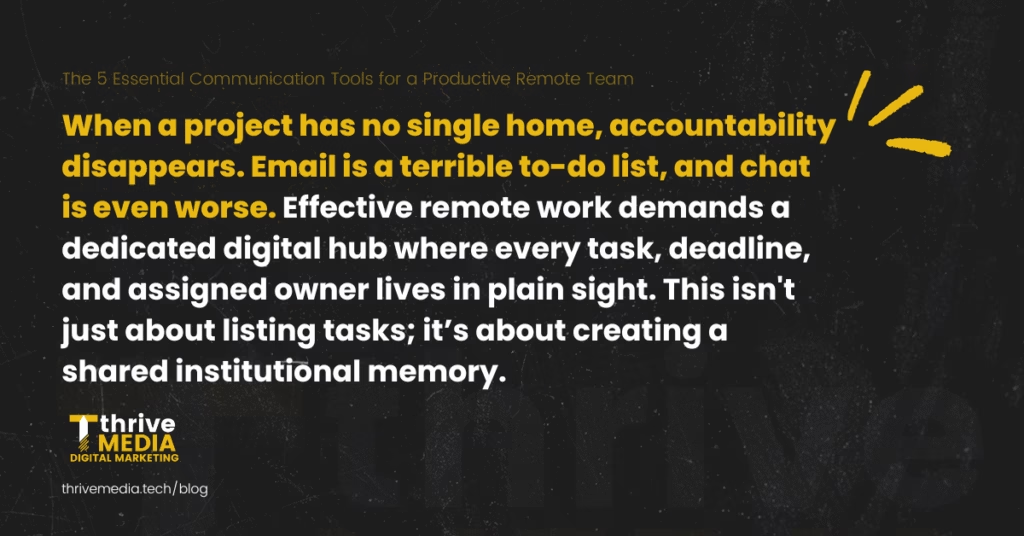
When a project has no single home, accountability disappears. Email is a terrible to-do list, and chat is even worse. Effective remote work demands a dedicated digital hub where every task, deadline, and assigned owner lives in plain sight. This isn’t just about listing tasks; it’s about creating a shared institutional memory.
A high-performing virtual team uses a powerful Project Management (PM) system like Asana, ClickUp, or Monday, as the ultimate source of truth.
- The Clarity Factor: It allows leadership to see, at a glance, the status of every deliverable without having to interrupt anyone. The context, files, and conversation related to a task are all in one place, preventing the costly back-and-forth of “Where is that document?”
- Asynchronous Alignment: This platform should be the primary space for asynchronous communication. Team members update their tasks when they finish them, not when they are asked. This respects focused work blocks, which are the engine of genuine productivity for your offshore support team and your internal leadership.
The tool is only as good as the process. Define exactly what information must be in a task (owner, deadline, linked file) and definition of ‘done’ and enforce it. This discipline is the difference between a functional platform and digital chaos.
2. The Virtual Water Cooler: Real-Time Messaging
You can’t eliminate the need for an instant ‘tap on the shoulder.’ This is where a dedicated real-time messaging app, like Slack or Microsoft Teams, becomes an essential communication tool for remote teams. Its purpose is clear: rapid-fire, informal, and non-essential conversation.
The mistake many companies make is treating their chat app like a replacement for all other communication. This must be avoided.
- The Rule of Channels: Segment conversations ruthlessly. A channel for urgent IT issues, one for client-specific updates, and one for non-work socialization. This segmentation is key to reducing noise and improving information retrieval.
- Status Signals: Encourage the use of status indicators (e.g., “In a deep-work block,” “At lunch,” “Offline”) to set crystal-clear expectations around response times. Your team should understand that a message sent in a chat platform is not a guarantee of an immediate answer; unless it is explicitly flagged as urgent in the designated, urgent-only channel.
If your message is more than three sentences long, or if it has an attachment, it needs to move to email, a task in your PM system, or a video call. Keep the chat app strictly for the digital equivalent of a quick wave across the office.

3. The Trust Builder: High-Quality Video Conferencing
There are certain moments that demand synchronous, face-to-face interaction: the kickoff of a major initiative, a complex brainstorming session, or a crucial one-on-one coaching moment. Video conferencing (Zoom, Google Meet, etc.) is the best way to bridge the gap of distance and allow for the reading of non-verbal cues.
While we advocate for using asynchronous communication as a default, a video call is an invaluable tool for building connection and trust, especially when you are working with talent overseas.
- The Power of Preparation: Unproductive meetings kill motivation. Every video call must have a clear, pre-sent agenda and a defined goal. If you can’t state the goal in one sentence, cancel the meeting and use asynchronous communication instead.
- Post-Call Records: The crucial step that is often missed is documentation. A short, documented summary of decisions made and action items assigned must be logged in the PM tool immediately after the call. This locks in accountability and ensures the time spent in the call actually translates into forward momentum.
4. The Repository: Centralized Document Storage
Knowledge silos are the silent killer of virtual team productivity. When key documents, standard operating procedures (SOPs), or client credentials are saved on a local desktop or buried in someone’s email, the entire operation becomes brittle and reliant on individuals.
The solution is a centralized, cloud-based document repository (Google Drive, SharePoint, Dropbox).
- The Findability Test: This system needs structure. Use a standardized, company-wide naming convention and folder structure. If a new hire or a virtual executive assistant cannot find a critical document within two clicks, the structure is failing.
- Ownership and Access: Ensure that ownership of all critical documents rests with the company, not an individual. This seamless transfer of knowledge is essential for continuity and scale. An optimized system allows your offshore support team to access, update, and collaborate on files in real-time, eliminating the version-control nightmares that plague less structured companies.
5. The Formal Record: Professional Email & Calendar Suite
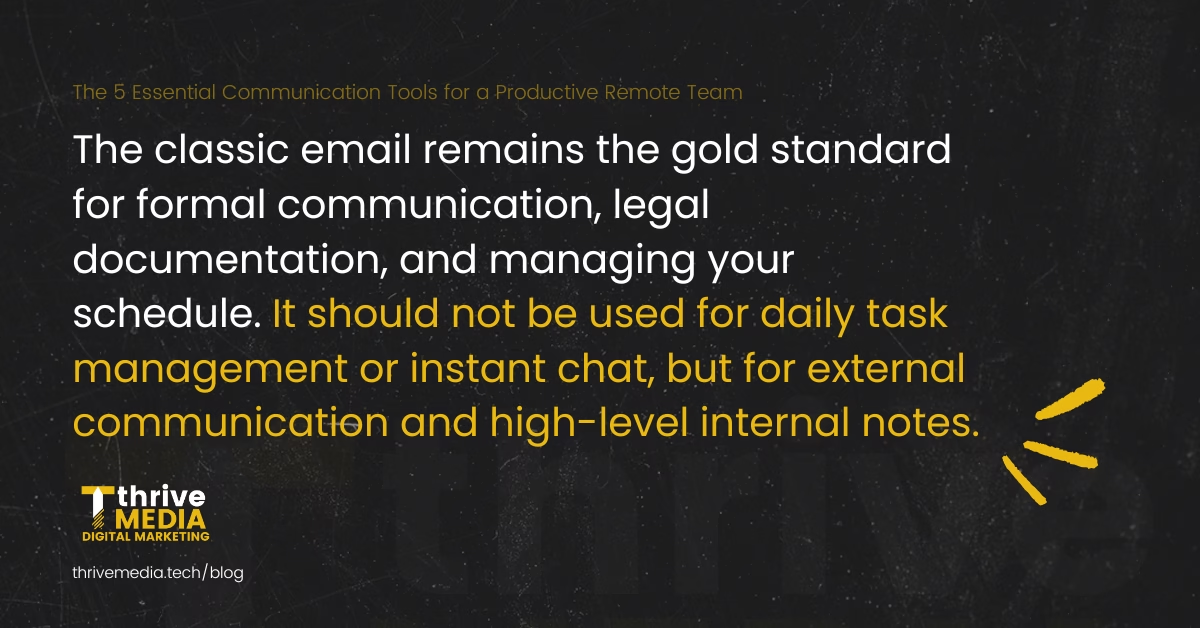
The classic email remains the gold standard for formal communication, legal documentation, and managing your schedule. It should not be used for daily task management or instant chat, but for external communication and high-level internal notes.
This is a vital, separate pillar in your communication stack, serving as the professional front of your business and the bedrock of schedule management.
- Calendar Clarity: An open, up-to-date calendar suite is a non-negotiable for smooth remote team communication. It eliminates the friction of scheduling meetings across different time zones. Encourage team members to mark focused work blocks, not just meetings, so colleagues understand when they are genuinely unavailable for rapid synchronous interaction.
- The External Face: The language and structure used in professional emails directed at clients and partners reflect the company’s discipline. Train your remote team to use clear, concise subject lines and bulleted action points to ensure every communication reinforces a perception of efficiency and professionalism.
Final Verdict: The Guide to Greater Impact
The shift to a global, virtual operational model isn’t just about saving money; it’s about unlocking superior performance. The key is to stop simply accumulating applications and start designing an efficient, deliberate communication environment.
The tools listed here are merely the foundation. The real win comes from defining when and how each one is used. By implementing a disciplined communication stack, your business moves past the constant noise and enters a phase of streamlined operation, transforming the potential of your distributed team into quantifiable results.
Ready to stop managing communication chaos and start leveraging a highly effective, strategically supported global team? We specialize in building and integrating these processes, connecting you with the right support to make your remote operation a definitive competitive advantage.